Overview :
Learn strategic presentation skills lessons from Elon Musk — how to hook audiences, prove bold ideas and lead with conviction and strategic impact.
Most corporate presentations are forgettable.
They are polished. Structured. Safe. And entirely predictable.
Billionaire genius Elon Musk proves something uncomfortable for many executives: presentation skills are not about polish. They are about impact.
Musk hesitates. He stumbles. He thinks aloud. Yet when Musk presents — investors listen, markets react and headlines follow.
Why?
Because powerful executive presentation skills are built on conviction, clarity, evidence and strategic theatre — not rehearsed perfection.
For leaders in financial services, asset management and corporate environments, there are hard-edged lessons here.
Let’s examine them.
-
If You Don’t Hook Them Immediately, You’ve Lost Them
The first minute of a presentation is not warm-up time. It is the battleground for attention.
Too many executives begin with agenda slides and historical context. Attention evaporates before the strategy appears.
Musk understands a brutal truth: attention must be earned.
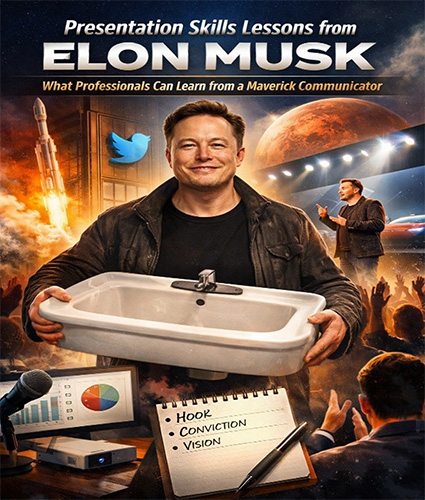
On 26 October 2022, just before finalising his acquisition of Twitter (now X), Musk walked into the company’s headquarters carrying a porcelain sink.
He posted the video with the caption:
“Entering Twitter HQ — let that sink in …”
It was bold and absurd. Completely intentional. And totally memorable.
Before any formal press briefing, Musk had achieved what most corporate announcements never do: global attention. The image went viral instantly. He controlled the narrative before a single spreadsheet was discussed.
That is what a hook does.
In boardrooms and investor presentations, you do not need theatrics — but you do need tension.
Open with:
- A question that reframes risk
- A data point that challenges assumptions
- A bold statement that disrupts comfort
If your audience is not leaning forward in the first 60 seconds, your presentation skills need recalibration.
-
Show the Real Thing — Evidence Crushes Scepticism
In 2008, Tesla was close to collapse. Cash was thin. Bankruptcy was plausible.
Musk pitched Daimler on a strategic partnership not with visionary rhetoric — but with working electric vehicle technology. He demonstrated real battery systems developed for the Roadster programme.
Not slides. Not projections. Proof.
Daimler was impressed enough to acquire roughly a 10% stake in Tesla and enter a collaboration. That investment became a turning point in Tesla’s survival.
Musk later compared the moment to “Gutenberg asking someone to make a printing press for him.”
Here is the presentation skills lesson executives often ignore:
- Show the real thing.
- Demonstrate instead of describing.
- Replace abstraction with evidence.
If you are pitching a new strategy, show live data.
Use concrete language; not vague abstract language.
If you are selling innovation, demonstrate capability.
If you are claiming transformation, prove results.
Evidence shortens debate. Substance silences doubt.
-
Conviction Beats Polish Every Time
Musk routinely violates classic public speaking rules. He pauses awkwardly. He searches for words.
Yet people listen because he believes what he is saying.
Conviction carries more weight than choreography.
In corporate environments, leaders often hide behind immaculate slides. But if belief is weak, audiences sense it immediately.
Executive presentation skills are not about flawless phrasing. They are about visible commitment.
If you do not sound convinced, neither will your audience be.
-
Create Drama — Intentionally
Musk understands that memorability requires contrast.
Unexpected reveals. Sharp reframing. Controlled surprise.
Drama is not exaggeration. It is strategic emotional design.
When pitching disruptive electric vehicles to legacy automakers, Musk did not ask for belief. He forced reconsideration through undeniable demonstration.
In corporate communication, drama can be created through:
- A powerful before-and-after comparison
- A decisive strategic pivot
- A live example
- A bold visual reveal
Memorable presentations are engineered. They do not happen accidentally.
If your stakeholder presentation feels flat, the issue is rarely data. It is energy.
-
Substance Over Hype Builds Authority
Musk’s slides are sparse. Often just a phrase. A diagram. A visual cue.
He does not overwhelm audiences with bullet storms.
Too many executives confuse volume with value. They flood slides with metrics and expect comprehension.
Here is the reality: dense slides reduce engagement and signal insecurity.
Corporate presentation training should teach this relentlessly — clarity signals authority.
One idea per slide.
One argument per section.
One clear takeaway.
When ideas are strong, they do not need camouflage.
-
Imperfection Can Strengthen Trust
Musk’s delivery is not smooth — and that is precisely why it works.
In an age of rehearsed corporate messaging, slight imperfection feels human.
This does not mean being unprepared. It means avoiding robotic recitation.
Prepare your thinking thoroughly.
Deliver it as thought, not theatre.
Audiences trust leaders who appear to be thinking in real time.
Mechanical delivery kills credibility. Natural conviction builds it.
-
Turn Monologues into Strategic Conversations
The strongest presentation skills do not dominate a room — they engage it.
Musk frequently responds directly to questions and adjusts his explanations dynamically.
In investor briefings, board meetings and client presentations, dialogue is influence.
Practical execution:
- Ask rhetorical questions that provoke reflection
- Address objections before they surface
- Invite clarification
- Validate intelligent scepticism
When stakeholders feel heard, resistance drops.
Presentations are not performances. They are negotiations for belief.
-
Anchor Everything in Vision — Then Validate It
Musk rarely discusses a product without linking it to a mission. Electric vehicles are about sustainable energy. Rockets are about multiplanetary civilisation.
Vision gives data meaning.
But vision alone is not enough.
The Daimler partnership validated Tesla’s credibility. External endorsement amplified trust. Strategic alliances signalled legitimacy.
For executives, the dual lesson is clear:
- Anchor your message in purpose.
- Reinforce it with credible validation.
In financial services, this may be regulatory backing, institutional partnerships or proven track records.
Vision attracts attention. Validation secures confidence.
-
Mastery Enables Freedom
Musk’s delivery appears spontaneous because his knowledge is deep.
He understands the engineering, the financials and the operational realities.
Confidence without competence collapses under scrutiny. Competence creates freedom.
For leaders refining executive presentation skills:
- Clarify the core argument.
- Anticipate the toughest question in the room.
- Know your numbers without glancing at slides.
- Distil your message into one decisive takeaway.
Preparation is not memorisation. It is intellectual control.
When you master your material, you can focus on influence.
The Real Point
Elon Musk’s presentation style is not a template to imitate.
It is a wake-up call.
Most corporate presentations are overly cautious, over-designed and underpowered.
Strong presentation skills demand more:
- Courage to open boldly
- Discipline to simplify
- Evidence to persuade
- Vision to inspire
- Mastery to respond under pressure
When those elements combine, presentations stop being routine updates — and start becoming turning points.
Elevate Your Executive Presentation Skills
If your board presentations feel safe but forgettable…
If your investor briefings inform but fail to influence…
If your stakeholder communication lacks energy…
It is time to sharpen your saw.
Communication Guru’s customised presentation skills training equips executives to communicate with authority, clarity and measurable impact.
We help leaders transform technical expertise into persuasive narrative — particularly in financial services and asset management environments where credibility matters most.
👉 Contact us to design a tailored programme for your team.
Email: john@communicationguru.co.za
Stop presenting safely.
Start presenting strategically.


